
Why do Koreans ask your age? In Korean, the way you talk changes depending on whether the other person is older or younger than you. There is a polite way of speaking, jondaenmal (존댓말), and a casual way, banmal (반말). What you call the person changes too. So age is the information that decides how the conversation will go.
It’s also about getting closer
What happens after a Korean asks your age
Here is the short version:
- You tell each other your age, or the year you were born.
- If you are the same age, you become friends. You may agree to use banmal with each other.
- If your ages are different, the younger person calls the older one hyung, noona, oppa, or unnie. The older person calls the younger one by name, or talks to them casually.
How does Korean age work now?
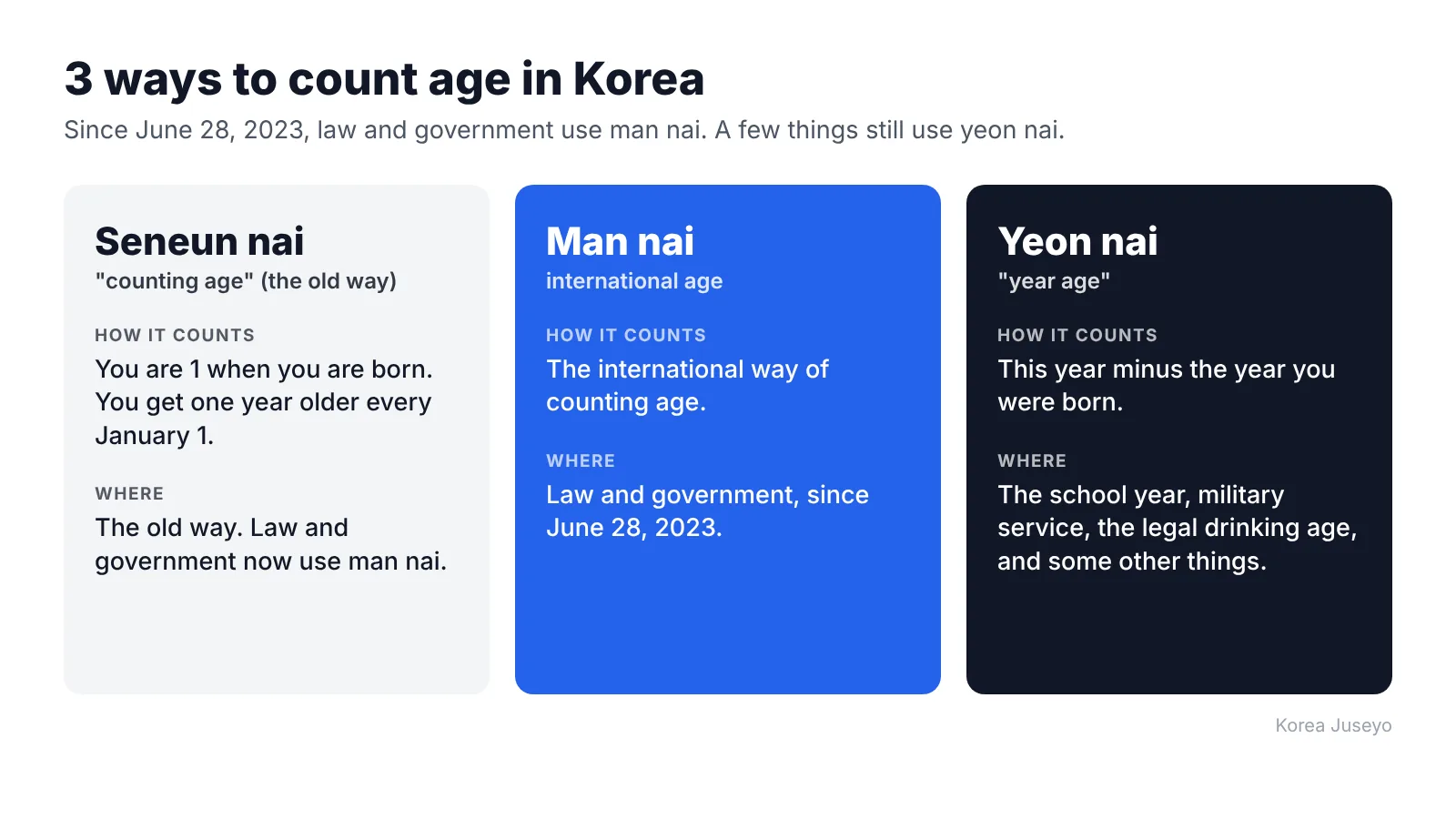
- The old “counting age,” seneun nai (세는 나이): you are 1 year old when you are born, and you get one year older every January 1.
- Since June 28, 2023, Korean law and government use man nai (만 나이), the international way of counting age.
- But some things still use “year age,” yeon nai (연 나이). That is this year minus the year you were born. It is still used for things like the school year, military service, and the legal drinking age.
Source: Al Jazeera on the 2023 switch to international age
What is ppareun nyeonsaeng? Korea’s “early birthday” kids
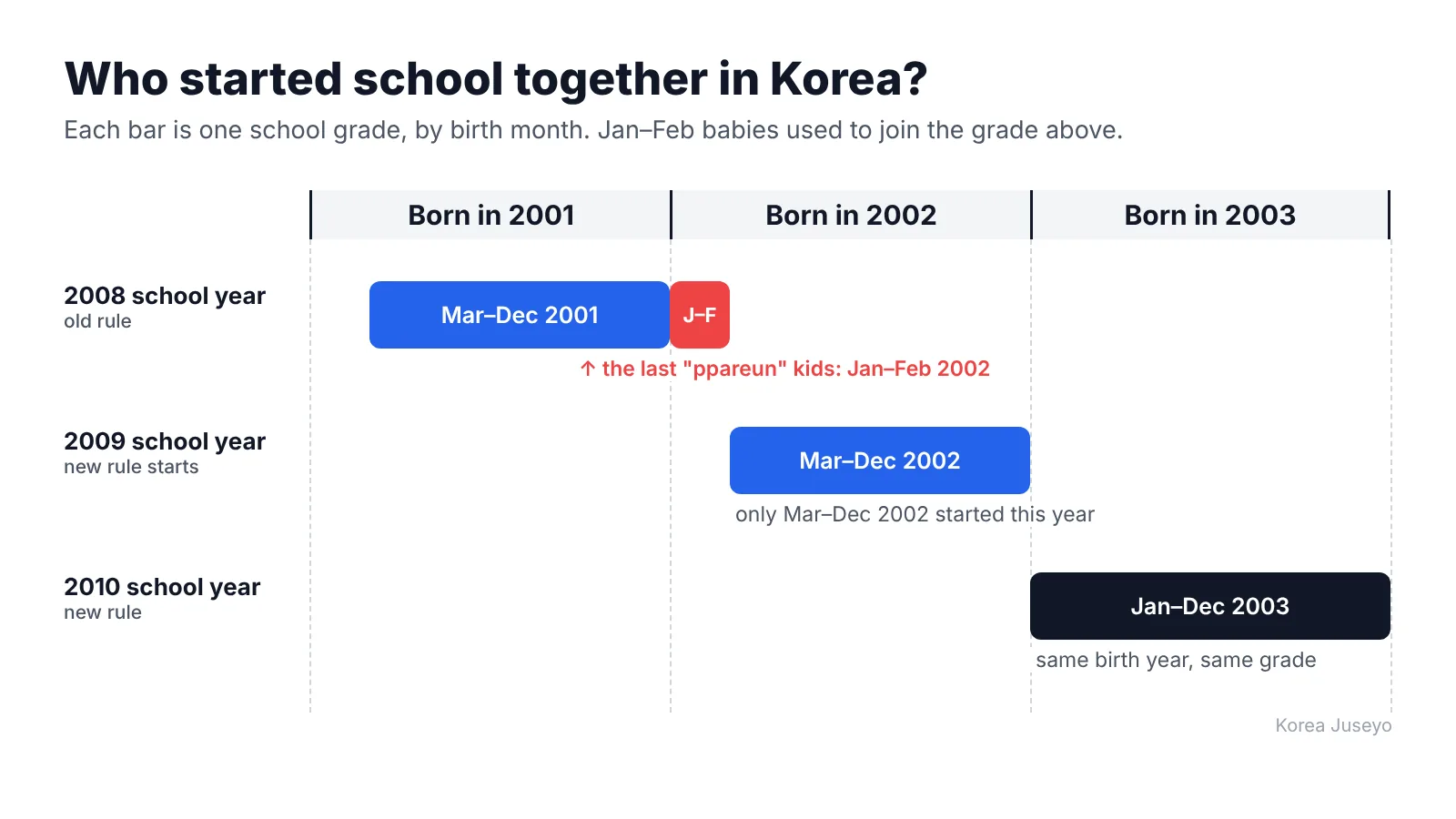
Up to the 2008 school year, kids born between March 1 and the end of February the next year started school in the same grade. So kids born in January and February were one grade above the other kids born in the same year. Koreans call them ppareun nyeonsaeng (빠른년생). Ppareun means “early.”
This is why the age order gets tangled. At school, these kids grew up as friends with the kids in their grade, one grade above the others born in their year. But by birth year, they were born in the same year as the kids one grade below them. So once they are out in the adult world, it is unclear: do you go by school grade, or by birth year?
The law changed. From the 2009 school year, kids born from January 1 to December 31 start school in the same grade.
The last ppareun kids were born in January and February 2002. They started school in the 2008 school year. In 2009, only kids born from March to December 2002 started school. Kids born in January and February 2003 started in 2010, together with the other kids born that year.
Source: Hanguk Gyoyuk Sinmun (한국교육신문) on the 2009 school entry change
So these days, the law has changed in two ways: the early-birthday school start is gone, and age in law now means man nai.
The Korean age hierarchy: what I’ve seen
These days, young people often don’t ask your age, because it might be rude. They worry that sharing ages could actually get in the way of becoming close.
But I think inside, you still quietly wonder, “How old is that person?”
I think that shows how much age matters in Korea. When you look at what someone does or says, you have a standard in the back of your mind: “At this age, you should act at least this grown-up!”
It is the same at work. There is a company culture of quietly looking down on people who are young, or trying to push them down.
So some companies give out business cards with a job title one or two levels higher than the real one. They worry that the real title will put them at a disadvantage in business.

Tips for foreigners when a Korean asks your age
- A thoughtful Korean may not ask your age first, because it is not a culture foreigners are used to.
- If a Korean asks your age and suggests what to call each other, it may mean they want to be close. You can be happy to hear it.
- And you will probably be surprised a lot when you hear a Korean’s age. Koreans look young for their age!
Korean age FAQ
Why do Koreans ask your age so soon after meeting you?
Your age decides how they talk to you and what they call you. Often, it also means they want to get closer. With people Koreans only deal with for business, they never ask.
Is it rude to ask a Korean their age?
Usually not. Koreans often ask to get closer. But these days, many people are careful about asking right away when they first meet someone. If the other person asks you first, it is fine to answer.
What is Korean age now?
Since June 2023, law and government use man nai. The school year, military service, the legal drinking age, and some other things still use yeon nai.
What does ppareun nyeonsaeng mean?
Up to the 2008 school year, kids born in January and February started school one grade above the other kids born in the same year. The last ones were born in January and February 2002.
Do I have to call someone “hyung” or “unnie”?
If the other person suggests it, it may mean they want to be close. But it is not required.
Last checked: November 24, 2026