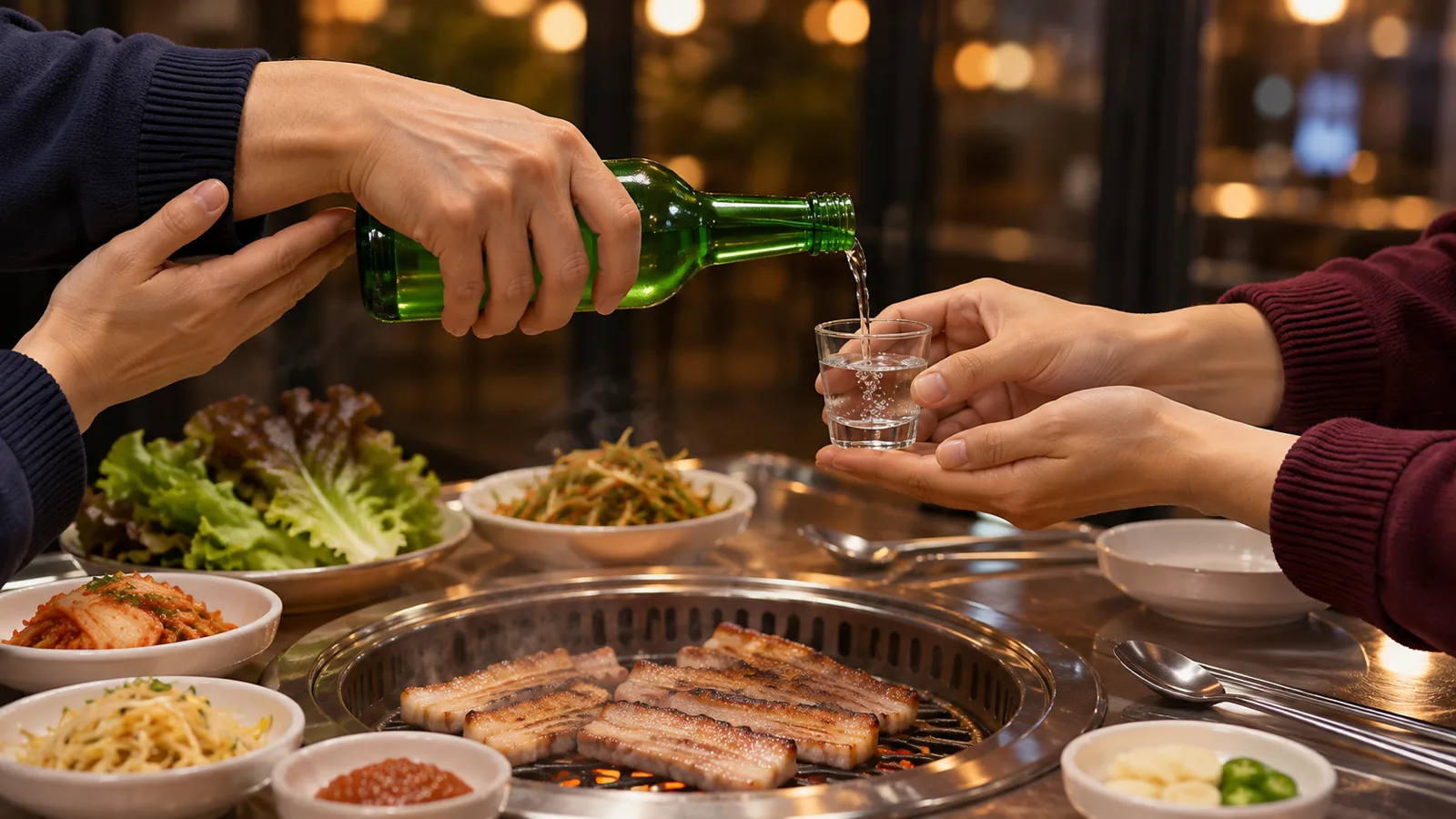
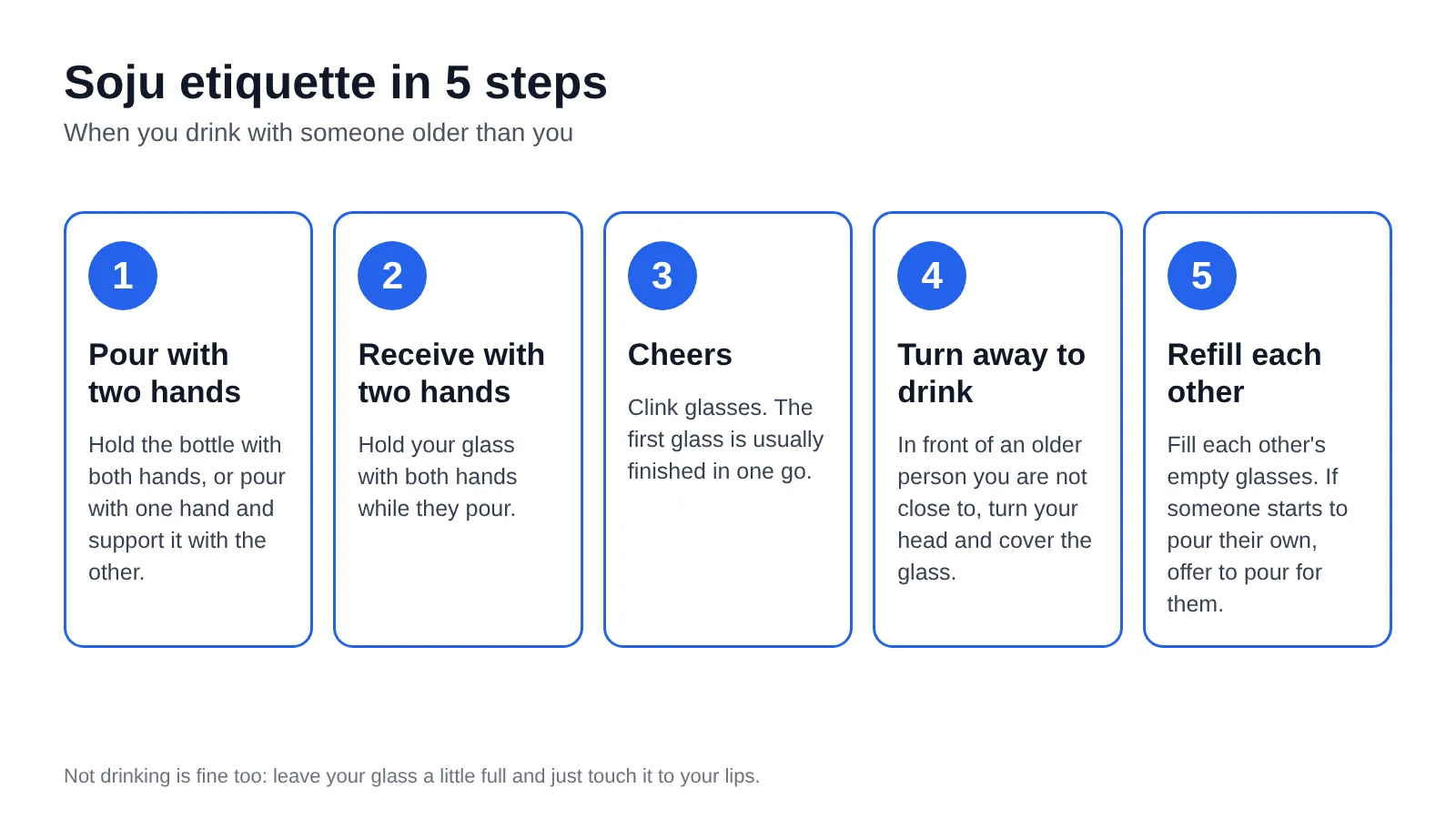
Soju is served cold, in small glasses, with food. How to drink soju with Koreans comes down to a few habits: use two hands when you pour for an older person or take a drink from them, turn your head away when you drink in front of them, and don’t fill your own glass. You fill each other’s. The first glass is usually one shot.
And in Korea today, it is fine not to drink at all. I’ll come back to that, because a lot has changed since COVID.
Where I learned Korean drinking etiquette
Usually, Koreans learn these rules from their father or from a close senior, someone a bit older at school or at work. I learned from my father.
Once, I tried to take a glass from him with one hand. He told me that when an older person pours you a drink, you hold the glass with both hands.
If you have read why Koreans ask your age, this etiquette is where that age order is most visible: at the drinking table.
How to drink soju with an older person: two hands
When you pour for someone older, you also use both hands. You can hold the bottle with two hands. Or you can pour with one hand and support it with the other. Any way is fine, as long as it is clear that you are using both hands.
Giving or taking with one hand is seen as something you do with people younger than you. If you do it to someone older, it is seen as very rude.
Receiving works the same way. Wikipedia’s page on Korean drinking culture describes it like this: when an older person pours for you, you hold the glass with both hands, with your left palm under the glass and your right hand holding it.
Why do Koreans turn away when drinking?
Wikipedia says that when you drink in front of an older person, you turn your head away and cover your mouth and glass with your hand.
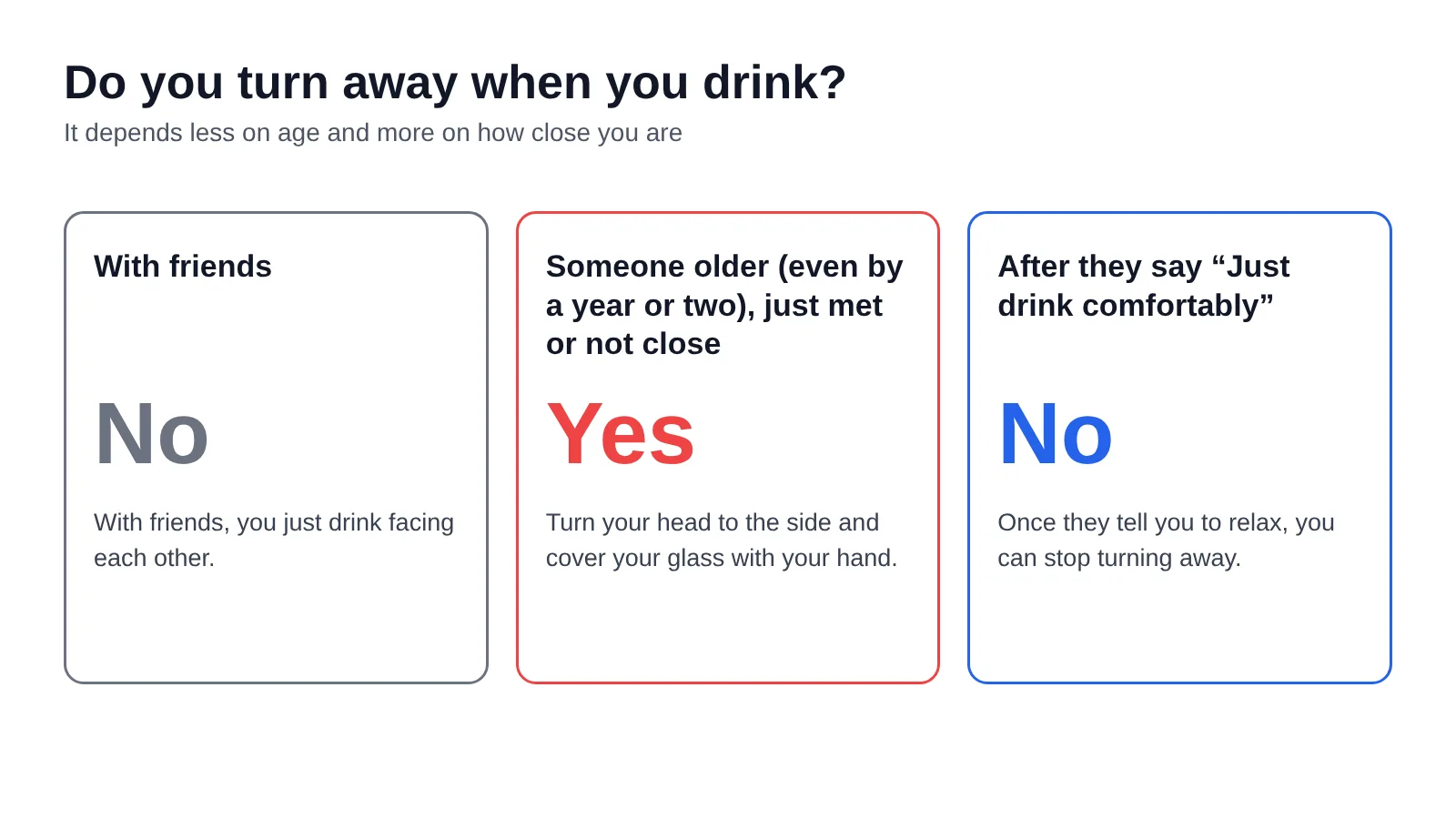
But who counts as “older”? For me, it works like this.
- With friends, I don’t turn away.
- With someone only a year or two older, if we just met or we are not close, I turn away to be polite.
- If that person says “Just drink comfortably,” I stop turning away from then on.
So the rule depends less on age itself and more on how close you are to the person.
Why you don’t pour your own glass: jeong
In Korea, filling each other’s empty glasses is jeong (정). It means you are looking after that person.
If someone at the table ends up pouring their own drink, it means I didn’t take care of them properly. So when someone starts to pour for themselves, the people around them hurry to say, “Let me pour for you.” That is Korean jeong.
Wikipedia also describes a related custom: when you empty your glass, you hand it back to the person who poured for you and pour them a drink.
Soju etiquette for the first glass, and shaking the bottle
The first glass is usually one shot (원샷), finished in one go. Unless someone doesn’t drink at all, the first glass is one shot, even if it is the only one they finish that way. Wikipedia also says the first glass is emptied at once.
You could call it a kind of ritual. You are there to drink and have a good time, and the first shot lifts the joy and the mood of the table. If people split the first glass into sips, the fun goes flat right away. Nobody says it out loud, but that is the shared feeling.
Before opening the bottle, a lot of people shake it and hit the neck of the bottle. I think I have almost never seen anyone just open it. There is nothing settled at the bottom of soju, but people always do it anyway. It doesn’t really mean much.
Why do we do it? This is only my guess. In the old days Korea was not very rich, so distilled drinks like soju were mostly for the upper class. Ordinary people drank a lot of makgeolli (막걸리) or dongdongju (동동주), drinks with bits that sink to the bottom. Those taste right only when the bits are mixed back in, so you have to shake them. I think that habit carried over. And I think some fun got added on top: the little whirlpool inside the bottle when you shake it, and hitting the neck. It is a bit of a performance.
How to say no to a drink
You can just say, “I won’t drink any more than this.”
Or here is another way. Keep a little soju in your glass, do the cheers, and only touch the glass to your lips. Keep it from getting empty. Then nobody has a reason to pour for you.
If you are a visitor, you don’t have to drink. These days that is even more true, because of the changes below.
Korean drinking culture after COVID: fewer drinking nights, more drinking alone
These days, company dinners, called hoesik (회식), almost never turn into drinking nights. At work, people often have a team lunch instead. Friends also often eat, go to a cafe, and then go home.
But when a company dinner does turn into drinks, people keep the etiquette even more carefully, because it is a drinking table at work. Among young people, though, it does feel a bit looser than before.
Korea really drinks a lot less now, especially since COVID. A lot of people realized something: “Wait, I can keep my friendships and make new friends without drinking? And if I skip the company dinners I never wanted to go to, I get more free evenings. This is great!”
The numbers show it too. According to the National Tax Service, Korea’s liquor shipments in 2025 were 2.99 million kiloliters, the lowest in 27 years, as Korea JoongAng Daily reports. The same article says forced drinking and pressure to attend company dinners are no longer taken for granted, and that young people are mainly behind the drop.
Household spending fell too. In the first quarter of 2026, the average household’s monthly real spending on alcohol was 9.0% lower than a year before. That was the biggest drop since the current household spending series began in 2019 (article in Korean). Wikipedia also says drinking has been falling since the mid-2020s, because people care more about health and because company culture changed after COVID.
Drinking alone: honsul
Drinking alone, honsul (혼술), is something young Koreans enjoy often these days. There are far fewer group drinking nights, so people who love to drink often enjoy it on their own.
Young people in Korea have become much more individualistic. With honsul, you don’t need to set a time with anyone. You can wear comfy clothes, watch a TV show, YouTube, or Netflix, pick the side dishes you want, and drink at your own speed.
Money is part of it too. Prices have gone up like crazy in the last few years, much faster than salaries. So buying soju at the supermarket and drinking at home costs less. A bottle that is 2,000 to 3,000 won at the supermarket costs 6,000 to 8,000 won at a bar. These are prices I have seen myself, as of November 2026.
What does soju taste like, and should you try it?
Soju tastes bitter. It is bitter, but you drink it because it goes with good food and you can get pleasantly drunk.
It is not a drink you enjoy for lots of different smells and flavors, the way you would with German beer.
Still, I recommend it to visitors. It is the perfect chance to feel Korean culture, food, the mood of the streets at night, and the etiquette, all at once. And if you don’t drink, that’s fine too.
FAQ
Is it okay to drink soju alone?
Yes. Drinking alone (honsul) is common in Korea now, especially among young people.
Do you have to shake the soju bottle?
No. It doesn’t really mean much, so you can just open it.
Do Koreans turn away when drinking with friends?
No. With friends, you just drink facing each other.
Last checked: November 25, 2026. The soju prices are what I have seen myself, not official numbers.